The Washington Post: is it telling the whole story?
Analysis: How Washington Post strips casualties from covert drone data
By Chris Woods / November 1, 2012
Alongside the
Washington Post’s
latest blockbuster reports on the Obama administration’s drone kill list is a
new graphic, depicting US covert strikes since 2002.
Based on studies by monitoring organisations, the graphic lists hundreds of US drone strikes in Pakistan, Yemen and Somalia, in what the paper says will be a regularly updated project. Also detailed are ‘the names of prominent militant leaders killed in individual strikes,’ the paper says.
But there the information stops.
All other casualty information has been stripped from the Washington Post’s data. There is no reference to the numbers reported killed in each strike. No names or numbers are put to the civilians killed.
In short, the paper has removed much of the information that is most valuable for assessing the effectiveness of the US drone campaign.
As a series of emails between the Washington Post and the Bureau reveals, the decision to strip out pertinent casualty data was an editorial one, and was part of broader ‘reservations and concerns’ at the paper concerning casualty counts.
An examination of the Post’s reporting indicates the paper frequently omits credible reports of civilian deaths in US covert drone strikes.
So concerned was the Bureau at the Washington Post’s intention to strip away casualty information that it has refused permission for the paper to use its work in such a significantly amended form.
‘No casualty counts’
The graphics editor of the Washington Post first approached the Bureau directly on September 18 asking to make use of the Bureau’s full dataset, having initially tried to obtain the information indirectly via the Guardian.
The Bureau allows full and free access to its data under a Creative Commons licence. In recent weeks, both the Guardian in the UK and Al Akhbar in Lebanon have used its data to map drone strikes in Pakistan and Yemen.
In a series of emails with senior Bureau staff, the Washington Post graphics editor noted that ‘TBIJ indeed does have the most accurate and comprehensive public representation of drone strikes.’
Nevertheless the Post’s plan was to aggregate data from the Bureau, the New America Foundation and the Long War Journal ‘in a way that will not highlight casualty counts’.
In response the Bureau noted that while drone casualty counts are a challenge, ‘who dies, and in what numbers, are the most critical questions that the data can address’.
The Bureau went on to ask: ‘Are you aiming to name militant leaders killed, for example, or only to map the locations of each strike/ frequencies? If the former, there is surely also a necessity to name all civilians recorded killed. If you only map events, how does a user distinguish between a strike that kills no one and an event that kills 80?’
In response, the graphics editor wrote on September 24: ‘I’ve spoken to editors and reporters on our foreign desk on Friday. Due to the same reservations and concerns about the casualty counts that I mentioned previously, we will not be showing casualty counts.’
The Bureau’s managing editor Iain Overton expressed concern about the Washington Post using Bureau data in such an altered form. The Post’s published graphic only employs New America Foundation and Long War Journal material – and all casualty counts have been removed.
Wider problem
The Washington Post’s wider coverage of drone strikes shows a reluctance to address civilian deaths, with credible reports often omitted.
There are issues around the recording of casualties from US drone strikes – civilian or otherwise – given the reporting challenges they present. Critics argue there is too much incentive for individuals to exaggerate claims of civilian deaths for propaganda purposes.
That does not explain why reported civilian casualties continue to decline steeply in Pakistan and elsewhere. Nor does it explain why casualty counts by the Bureau and others appear close to the US government’s own overall estimates of the numbers killed.
Claims of civilian deaths in Pakistan are generally uncommon, and significant information is often known about the victims. Of 41 CIA drone strikes between January and October, civilian deaths were confidently reported on four occasions. There are indications of possible civilian deaths in a further nine strikes.
By stripping away the casualty data I’m not sure what’s left. They have also introduced their own bias into the recording, by selectively choosing which information to retain’ - Elizabeth Minor, Oxford Research Group
The identities of civilian victims are known for three of the four attacks. On August 18 the wife of militant Ahsan Aziz died. Three days later a 13-year-old boy and relative of militant leader Badruddin Haqqani was reported killed. And on October 24 the wife of schoolteacher Reshmeen Khan died as she walked in a field adjacent to a drone strike
Only for an incident in May in which worshippers in a mosque were reported killed are there no biographical details in any of the reporting.
While the Washington Post frequently notes the deaths of senior militants, no mention of reported civilian casualties was made by the Post for three of the four 2012 cases cited above. Only for the October 24 event did the Post run an agency report stating that a woman had probably been killed.
The deaths of 11 civilians in an alleged US drone strike in Yemen on September 2 was also not reported by the paper, it seems.
In response to a recent complaint about its coverage of non-combatant deaths, the Washington Post insisted that it is ‘committed to documenting the deaths of civilians, as our coverage broadly shows.’
‘Dangerous editorial cut-off’
Just down the road from the Washington Post’s headquarters, experts gathered in the city on October 22 for the release of the largest-ever study into the recording of casualties in conflicts.
Funded by the Swiss government and the US Institute of Peace, the Oxford Research Group report examined casualty recording by more than 40 organisations (including the Bureau) across the world. It concluded that ‘useful documentation of deaths from conflict can be done even during intense conflict, and in repressive and dangerous environments.’
Elizabeth Minor, the report’s author, expressed surprise that the Washington Post would remove what she says is the most important information being collected, no matter how incomplete.
‘By stripping away the casualty data I’m not sure what’s left. They have also introduced their own bias into the recording, by selectively choosing which information to retain,’ Minor told the Bureau.
‘A better approach might be for the Post to publish all available information, transparently sourced, and so allow the reader to make up his or her mind as to its validity.’
The decision by the Washington Post to strip away casualty figures from its data – and to downplay civilian deaths – appears at heart a political call. As the Bureau’s managing editor Iain Overton notes, ‘We would be very happy to work in collaboration with the paper on its coverage of drone warfare.
‘However, we believe that to give a full and comprehensive view of the current situation in Pakistan and beyond, it’s incumbent on journalists to include credible casualty reports. To ignore this area simply because the information is imperfect or awkward is a dangerous editorial cut-off.’
Source / Bureau of Investigative Journalism
Fluxed Up World
[+/-] Read More...
[+/-] Summary only...
The United States: An Impoverished, Delusional Society
A Black Agenda Radio commentary by Glen Ford / May 16, 2012
When Europeans resist corporate austerity measures, they are struggling to avoid “being forced to live like most Americans, at the total mercy of the rich.” The U.S. safety net hardly exists. The “American way of life” is a state of profound insecurity and social disconnectedness.
“Europe is headed for deep turmoil because Europeans have something to defend.”
Thanks to the U.S. corporate media’s great skills of obfuscation, omission and just plain lying, Americans are quite confused about the political and financial crisis in Europe, and what it means on this side of the Atlantic. People in the United States harbor vague fears that the social turmoil they see playing out in European elections and on the streets may come here. This scares them, which is almost funny, in a very sad way, since what European working people are struggling to avoid is being forced to live like most Americans, at the total mercy of the rich.
Europeans are righteously upset because they have something quite precious to lose: a social safety net that provides levels of security that Americans have never experienced, and that many cannot even imagine. Since most overworked or underemployed Americans don’t know how Europeans actually live, they find it difficult to understand what all the fuss is about. U.S. corporate media fill in the vast blanks in American consciousness with slanders against Europe – the relatively comfortable French and the devastated Greeks, alike – branding them all lazy slackers who don’t want to work hard or pay their bills. America’s damn near nonexistent social welfare structure is packaged as a virtue, while the sights and sounds of European protest are made to seem ominous, dangerous, selfish.
Most Americans of modest means don’t travel to countries where the people live better than they do, or are so oblivious that they don’t notice the deep social service networks that underlie these societies. Americans cannot understand, for example, that higher educational achievement is so often tied to strong national compacts among citizens and fundamental notions of social equality – these qualities being absent in American life. CNN is quick to cite figures on European unemployment, but tells its U.S. audience virtually nothing about the social safety net that makes unemployment in Europe a very different experience than being without a job in the United States.
“America’s damn near nonexistent social welfare structure is packaged as a virtue.”
A young relative of mine happened to graduate with a professional degree just in time for the 2008 meltdown, which wiped out all the new jobs in his profession. He sought work in France, being fluent in the language, and found it a far more welcoming society than his own. More than half of his rent was subsidized, because the French believe that people younger than 26 should have a chance to begin independent lives without undue burdens. My young Black American relative rode public transportation for half fare, as did his young French peers. While working, he considered getting another professional degree, which would have cost him less than $2,000 a year at a fairly prestigious French school. And he was a foreigner! A French student who had already paid into the health care system, could study for a year for less than $1,000.
My young relative eventually came home – because…well, this is home. It is a materially rich country, but one that is socially impoverished and, frankly, too ignorant to know it. Europe is headed for deep turmoil because Europeans have something to defend. They’ll fight to keep a decent social welfare net. The Americans don’t even know what a minimally just society looks like or feels like. We’ll have to create that society through struggle, and almost from scratch.
For Black Agenda Radio, I’m Glen Ford. On the web, go to BlackAgendaReport.com.
BAR executive editor Glen Ford can be contacted at Glen.Ford@BlackAgendaReport.com.
Source / The Greanville Post
Fluxed Up World
[+/-] Read More...
[+/-] Summary only...

Ethan Miller/Getty Images.A Sex Ed 101 Curriculum for ConservativesBy Amanda Marcotte / March 2, 2012
Recent national kerfuffles over abortion and contraception access bring up many important questions: Should employers retain control over your wages and benefits after they sign them over to you? Is contraception, a service used by 99 percent of American women, really so controversial? How much state regulation should there be over women’s most private decisions? But amidst all those questions is one overarching one: Do conservatives need a crash course in sex ed? [Radio show host Rush Limbaugh speaks at a forum hosted by the Heritage Foundation on the similarities between the war on terrorism and the television show 24, in Washington, June 23, 2006.
Usually, when we think of the sex education debate, we think of junior high and high school kids putting condoms on bananas. But recent events indicate that this country needs remedial sex education for adults, specifically social conservatives who wish to hold forth on reproductive rights without seeming to know the basics regarding who has sex and how it works in 2012. With that in mind, I designed a quick curriculum for these surprisingly necessary courses.
Intercourse 101: It Takes Two to Tango. After voting for a mandatory ultrasound bill that serves no other purpose than to shame abortion patients for their sexuality, Virginia delegate David Albo complained in the legislature that he’s not getting the sex he feels entitled to from his wife. CNSNews columnist Craig Bannister shamed women on the pill for being “sex-crazed co-eds” who exhibit too much “sexual zeal” — before ending his piece by wistfully wishing he could have sex with all the sexually active women he just insulted. Rush Limbaugh, who is on his fourth marriage and is an admitted Viagra user, called Sandra Fluke, a Georgetown University law student who testified before Congress about her use of contraception, a “slut” and a “prostitute.”
In this first section of the remedial sex education course, we will discuss this sexual double standard: When having sex, men are behaving well and women behaving badly. The midterm will be an essay on the following prompt: “If women are supposed to say no to sex, whom do you propose straight men sleep with?”
Contraception 101: History as Prologue. Many conservatives appear to believe that prior to the Obama administration requiring employers to fully cover contraceptive care as part of their health plans, contraception wasn’t considered a medical service, but something more like a party item you pick up with your beer and cigarettes. Tina Korbe of Hot Air argued that supporters of the new regulation “labor under the illusion that contraception is a medical necessity.” Limbaugh argued that health insurance covering contraception means women are “paid to have sex.” The reaction on the right suggests that this is the first time in history someone has suggested that contraception care be included in general health benefits.
During this portion of the class, we will look at the history of medicalized birth control. Students will learn (in conjunction with another mandatory class, The Pill 101) that the birth control pill has always been controlled by doctors and pharmacies, and that insurance companies treat it as medical care by offering the drug with a co-pay. Special attention will be paid to the 28 states that already require contraception coverage, the existing Medicaid coverage of contraception, and the Equal Employment Opportunity Commission decision that found that contraception coverage is a normal part of women’s healthcare that should be covered by healthcare plans.
Premarital Sex 101: A Quantitative Look. Underlying many of the arguments over women’s reproductive healthcare is a widespread fear of women using these rights to have sex outside of marriage. During the Arizona Republican primary debate, Rick Santorum blamed contraception for the problem of teen pregnancy, presuming that teenagers in a contraception-free world would instead abstain. Utah Republican state representative Bill Wright defended a bill banning discussion of contraception in schools by saying: “Why don’t we just be honest with them upfront that sex outside marriage is devastating?”
Contrary to students’ expectations, there is no high-level math prerequisite for this course. The statistics involved are relatively straightforward. Students will learn that 95 percent of Americans have premarital sex and have done so for decades [centuries - rdj] without bringing ruin to the nation. In addition, students will read literature showing that the teen pregnancy rate actually declined after the sexual revolution, leaving it at half the rate it was in the 1950s. Students will be asked to research why it is that blue states, where residents are more likely to use contraception and delay marriage, have lower rates of divorce and teen pregnancy.
The Pill 101: A Scientific Look. The ignorance on display on the right regarding the birth control pill, which has been around as a contraceptive for over 50 years, has been astounding. Limbaugh’s comment — “she’s having so much sex she can’t afford her own birth control pills” — indicates that he believes there’s a correlation between the number of sexual encounters and the number of pills necessary. Limbaugh also seems to think mothers and women who use birth control are mutually exclusive categories, saying: “How do you become a mom if you’re into birth control?” Additionally, with words such as “slut,” “prostitute” and “sex-crazed” flying around to describe women on hormonal contraception, it appears many conservatives believe that the drugs exist primarily for use by single women with multiple partners.
Students in our remedial sex ed course will take their time learning about hormonal contraception. They will learn that women on the pill must take one every day for it to work, no matter how much sex they’re having. Students will discover that monogamy isn’t enough to prevent unintended pregnancy, and thus married and monogamous women use the pill just as single women do. To drive home what not using contraception would mean for women, married and otherwise, students will be asked to watch the TLC show about the Duggar family, with its 19 children, and then offer a five-minute presentation in class.
As evidenced by the ignorant rot tumbling out of various right-wing mouths in response to these controversies, a curriculum of this kind is sorely needed. Perhaps female Democrats in Congress can write a bill funding Sex Education for Grown-Up Pundits and help elevate the conversation with a little basic understanding.
[Amanda Marcotte blogs every day at Pandagon.net, and contributes a weekly podcast to RH Reality Check. She lives in Austin, TX with her two cats, boyfriend, and environmentally correct commuter bicycle.]
Source / Reuters
Fluxed Up World
[+/-] Read More...
[+/-] Summary only...
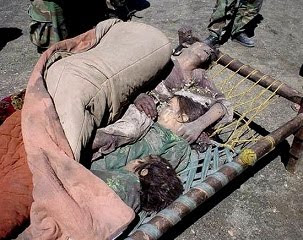
The Invisible Dead and "The Last Word": Lawrence O'Donnell 'Rewrites' the Occupation of Afghanistan
By Nima Shirazi / August 12, 2011
"It is my conviction that killing under the cloak of war is nothing but an act of murder." -- Albert Einstein
On Saturday August 6, 2011, a U.S. military Chinook transport helicopter was
shot down in Afghanistan, killing 30 American soldiers, including
17 elite Navy SEALs, and eight Afghans. The
mainstream news media was awash with somber
reports about this being the "deadliest day" for U.S. forces in the ten years since the invasion and occupation of Afghanistan began.
Notably, many
news outlets such as ABC,
NBC,
CBS, and
The Washington Post claimed the helicopter crash and its 30 American casualties marked the "deadliest day of the war", without adding the vital qualification, "for United States military personnel." Even the progressive website
Truthout provided its daily email blast that day with the headline: "Deadliest Day in Decade-Long Afghanistan War: 31 Troops Killed in Shootdown."
The obvious implication of these reports was that on no single day since October 7, 2001, when the U.S.-led invasion and bombing campaign began, had as many people been killed in Afghanistan as on August 6, 2011.
Perhaps most brazen and sanctimonious regarding this claim was MSNBC's primetime anchor Lawrence O'Donnell. Introducing the "Rewrite" segment of his Monday August 8 broadcast of "The Last Word", O'Donnell looked directly into the camera and, in his measured and most heartfelt serious voice, told his viewers:
"This weekend saw the worst single loss of life in the ten years of the Afghan War."
He was lying. Unless, of course, like so many Americans, O'Donnell doesn't count Afghan civilians as human beings worthy of being allowed to stay alive. In fact, the invisibility of the native population of Afghanistan is so ubiquitous in the American media, O'Donnell and his writers probably didn't even think they needed to acknowledge civilian death tolls at the hands of foreign armies. As General Tommy Franks, who led the invasions of both Afghanistan and Iraq, told reporters at Bagram Air Base in March 2002 when asked about how many people the U.S. military has killed, "You know we don't do body counts."
After showing a video clip of CIA Directer-cum-Defense Secretary Leon Panetta's statement that the helicopter crash served as "a reminder to the American people that we remain a nation still at war," O'Donnell took seven minutes of airtime to lecture his viewers about a country that has forgotten the hardships of warfare, due to the absence of a draft or rationing or war taxation. Clearly passionate and frustrated, he rhetorically wondered, "What kind of nation would need to be reminded that it is still at war?" He continued,
"There will be other nights for us to discuss the way forward or the way out of Afghanistan. Tonight is not that night. Tonight is for reminding this nation that it is indeed at war. And tonight is for reminding the nation of the price of war. The ultimate sacrifice."
At this point, O'Donnell displayed photographs of some of the soldiers killed in the crash while delivering brief biographies, a sort of "Last Word" eulogy for the dead.
In his effort to tug at his viewers heartstrings, O'Donnell told us of one young soldier who had only "been in Afghanistan for less than two weeks." Another was described by his mother as "a gentle giant." A SEAL Team 6 member also killed in the crash, we were told, had a wife, a two-year-old son and a two-month old baby girl while another solider was survived by his pregnant wife and three children. O'Donnell eulogized one of the deceased servicemen by telling us of his personal history as a high school wrestler and his lifelong dream of becoming a Navy SEAL.
O'Donnell concluded the segment with the assurance that none of the family members of those soldiers who had died - as opposed to the million of Americans whose lives are totally unaffected by the ongoing occupation - needed any "reminding" that "we are a nation at war."
Never once during this paean to the military did O'Donnell make even a passing reference to the thousands upon thousands of Afghan men, women, and children killed by U.S. and NATO forces in their own homeland, their own country, their own towns, their own communities, their own homes, hospitals, mosques, and schools, and at their own weddings.

The Afghan village of Karam was completely destroyed on October 12, 2001 when American forces dropped a one-ton bomb on it and killed over 100 people. On October 21, 2001, "At least twenty-three civilians, the majority of them young children, were killed when U.S. bombs hit a remote Afghan village," according to a report by Human Rights Watch.
Not a solitary syllable was uttered to honor the seven children blown apart "as they ate breakfast with their father" when "a US bomb flattened a flimsy mud-brick home in Kabul" on Sunday October 29, 2001. The Times of India, citing a Reuters report, revealed that "the blast shattered a neighbour's house killing another two children."
A few weeks later, on November 17, 2001, U.S. bombs fired at the village of Chorikori murdered "two entire families, one of 16 members and the other of 14, who lived, and perished, together in the same house," reported The Los Angeles Times. Shortly thereafter, heavy American bombing in Khanabad near Kunduz was said to have killed 100 people. The same day, a religious school in Khost was bombed, killing 62 people.
Around the same time, James S. Robbins, a professor of International Relations at the National Defense University, published an article in The National Review entitled, "Humanity of the Air War: Look how far we've come." The piece began this way: "Think airpower can't bring victory in Afghanistan? Think again."
Robbins continued his claim that "the air campaign over Afghanistan has been effective by most reports" and that "critics of the air campaign at home and abroad make as much of civilian casualties as suits their purposes, but arguments over whether a few, a dozen, or hundreds of people have died only show how civilized warfare has become." He averred that "[a]ny civilian deaths caused by allied bombs are unintended deaths" (emphasis in original), declared that the U.S. was using the "tools and means of the humane" to bomb Afghan civilians to death on a regular basis, and concluded, "The allied air campaign is demonstrating how moral a war can be."
On December 31, 2001, U.S. ground forces confirmed an enemy target in the village of Qalaye Niazi and "three bombers, a B-52 and two B-1Bs, did the rest, zapping Taliban and al-Qaida leaders in their sleep as well as an ammunition dump." A military spokesman, Matthew Klee, proudly told reporters that the strike was an unmitigated success, saying, "Follow-on reporting indicates that there was no collateral damage." However, The Guardian reported:
Some of the things his follow-on reporters missed: bloodied children's shoes and skirts, bloodied school books, the scalp of a woman with braided grey hair, butter toffees in red wrappers, wedding decorations.
The charred meat sticking to rubble in black lumps could have been Osama bin Laden's henchmen but survivors said it was the remains of farmers, their wives and children, and wedding guests.
They said more than 100 civilians died at this village in eastern Afghanistan.
In the first three months of the Afghanistan assault, Carl Conetta of the Project on Defense Alternatives found that upwards of 4,200-4,500 Afghan civilians had been killed as a result of the U.S.-led bombing campaign and the "starvation, exposure, associated illnesses, or injury sustained while in flight from war zones" that followed the invasion and airstrikes. In May 2002, Jonathan Steele of The Guardian reported that, up to that point, "As many as 20,000 Afghans may have lost their lives as an indirect consequence of the US intervention."
For O'Donnell, it appears the "price of war" doesn't include the 48 civilians killed and 117 wounded, many of them women and children, when U.S. jets bombed a wedding party in Oruzgan in July 2002, the 17 civilians, mostly women and children, killed by coalition bombs in Helmand in February 2003, the eight civilians killed by a U.S. gunship and bomber in Bagram Valley the same month, the eleven civilians killed, including seven women, by a U.S. laser-guided bomb that hit a house outside the village of Shkin in April 2003, the six family members killed by U.S. bombs that hit the village of Aranj in October 2003, or the nine children (seven boys and two girls aged 9 to 12) murdered by two U.S. A-10 Thunderbolt II planes which attacked the village of Hutala while the children were playing ball.
The human cost of the Afghan occupation, so far as O'Donnell is concerned, doesn't include the eleven people, four of them children, killed by an American helicopter which fired on the village of Saghatho in January 2004, the scores of civilians bombed to death by NATO airstrikes in October 2006, eight civilians shot by American soldiers in Kandahar in 2007, the more than 100 civilians killed in numerous U.S. and NATO bombings in May 2007, the seven children killed by a U.S.-led airstrike in June 2007, the group of bus passengers gunned down by US troops on December 12, 2008, the seven civilians killed by American troops in a rural village near Nad-E'ali in 2009, the 26 civilians, including 16 children, killed by British forces, the scores of dead civilians in Kunduz and Helmand who were killed by 500-pound bombs dropped by U.S. jets in September 2009, the 27 civilians killed by a NATO strike in the Afghan province of Uruzgan in February 2010, the five civilians, including two pregnant women and a teenage girl killed in Khataba, the 45 civilians (most of whom were women and children) murdered by a NATO rocket in Afghanistan in July 2010, the 30 or more civilians killed in two NATO air strikes on two villages in the Nangarhar province in August 2010, or the numerous civilian men, women, children, dogs, donkeys, and chickens slaughtered by Task Force 373, a clandestine black ops unit which NATO uses as an assassination squad.
On March 23, 2011, U.S. Army Specialist Jeremy Morlock was sentenced to 24 years in prison for the willful murder and mutilation of three Afghan civilians - a fifteen-year-old boy, a mentally-retarded man, and a religious leader. Other members of Morlock's platoon, the 5th Stryker Combat Brigade, have been "charged with dismembering and photographing corpses, as well as hoarding a skull and other human bones," The Washington Post previously reported. At the beginning of the court-martial proceedings, Morlock admitted to the military judge presiding over the case that the murders he and four fellow soldiers were charged with committing had been deliberate and intentional. "The plan was to kill people, sir," he said.
Broadcasting live across the country that evening, Lawrence O'Donnell didn't cover the story. Instead, he spent a considerable amount of airtime justifying Barack Obama's decision to begin bombing Libya, interviewing Anthony Weiner about healthcare, and poking fun at potential GOP presidential candidates. He ended the program that night, however, with a touching and earnest memorial for someone who had recently died: Elizabeth Taylor.
For O'Donnell, the "ultimate sacrifice" he spoke of this week naturally didn't include the Afghan man, four women, and baby murdered at a wedding party by a Polish mortar strike on the village of Wazi Khwa on August 16, 2007, which also injured three other women, one of whom was nine months pregnant. Nor does it include the "nineteen unarmed civilians killed and 50 wounded" when, during "a frenzied escape" on March 4, 2007, U.S. Marines "open[ed] fire with automatic weapons as they tore down a six-mile stretch of highway, hitting almost anyone in their way – teenage girls in fields, motorists in their cars, old men as they walked along the road." The April 2009 U.S. raid on Khost, which killed four civilians, including a woman and two children, didn't receive a sad obituary on primetime cable television either. The American soldiers on that raid "also shot a pregnant woman and killed her unborn baby, which had almost come to term."
To O'Donnell, the "worst single loss of life" in Afghanistan during the last decade wasn't the more than 140 civilians reportedly killed when "U.S. aircraft bombed villages in the Bala Boluk district of Afghanistan's western Farah province" on May 3, 2009 in what is now known as the the Granai airstrike. Reuters revealed that "93 of those killed were children -- the youngest eight days old," and that "[a]ccording to villagers, families were cowering in houses when the U.S. aircraft bombed them." The death toll of this one airstrike is nearly five times larger than the U.S. helicopter crash, which took the life of not a single civilian, let alone child.
255 civilians were killed in military operations in June 2008. In early July 2008, near the village of Kacu, "a U.S. air strike killed 47 civilians, including 39 women and children, as they were travelling to a wedding in Afghanistan...The bride was among the dead."
The following month, 90 civilians, including 60 children and 15 women, were killed during military operations in Herat province alone.
Sixty-five civilians, including 40 children, were killed in a NATO assault on Kunar in February 2011. A few weeks later, NATO helicopter gunners shot nine boys - aged 9 to 15 - to death as they gathered firewood. On May 28, 2011, NATO bombs killed two women and 12 children in Helmand. In the month leading up to the Chinook crash last week, dozens of Afghan civilians were killed in NATO airstrikes and raids.
O'Donnell didn't feel the need to show pictures of any of these victims or quote what their loved ones had to say about them.
The "deadliest day", in O'Donnell's estimation, could not possibly have been when, in July 2007, "U.S. special forces dropped six 2,000lb bombs on a compound where they believed a 'high-value individual' was hiding, after 'ensuring there were no innocent Afghans in the surrounding area'. A senior US commander reported that 150 Taliban had been killed. Locals, however, reported that up to 300 civilians had died."
Lawrence O'Donnell didn't tell his viewers of the hopes and dreams of the hundreds of Afghan children liberated forever from this world by noble American troops and their stalwart allies. He didn't mention how some of the young boys murdered by U.S. missiles loved to play soccer and couldn't wait to learn how to drive. He didn't solemnly note that many of the young girls shot to death by soldiers who love what they do wanted to become doctors and lawyers and human rights activists and teachers and wives and mothers. He didn't devote a segment of his show to the murder of Mohammed Yonus, "a 36-year-old imam and a respected religious authority", killed in Kabul in early 2010 while commuting to a madrasa where he taught 150 students." The New York Times reported, "A passing military convoy raked his car with bullets, ripping open his chest as his two sons sat in the car."
O'Donnell didn't tearfully point out that the bullets and bombs that have killed so many men and women have left countless orphans and widows and taken countless children away from countless parents all sacrificed on the altar of the so-called "War on Terror" and American security and exceptionalism.
None of these innocents - people obliterated in their own houses, in their own fields, and in their own cars on their own roads - was accorded a second of screen time or a moment of acknowledgment during O'Donnell's "Rewrite."
It is unsurprising that, in March 2010, General Stanley A. McChrystal told U.S. troops during a video-conference about civilian deaths at checkpoints in Afghanistan, "We have shot an amazing number of people, but to my knowledge, none has ever proven to be a threat." Nevertheless, upon McChrystal's dishonorable retirement only a few months later, Defense Secretary Robert Gates delivered the following tribute: "Over the past decade, arguably no single American has inflicted more fear, more loss of freedom and more loss of life on our country's most vicious and violent enemies than Stan McChrystal."
Lawrence O'Donnell, while chastising the American public for not paying enough attention to our myriad military invasions, occupations and war crimes, said that only "a nation whose news media is more troubled by the loss of credit-ratings than the loss of life" could act in such a way. He didn't mean, of course, the loss of Afghan lives, only of American soldiers. The U.S. government operates the same way; it still doesn't compile death tolls for its murderous operations. Earlier this year, the ACLU revealed [PDF]:
The Department of Defense has confirmed that it does not compile statistics about the total number of civilians that have been killed by its unmanned drone aircraft.
[...]
According to the DOD, the military’s estimates of civilian casualties do not distinguish between deaths caused by remote-controlled drones and those caused by other aircraft. While each drone strike appears to be subject to an individual assessment after the fact, there is no total number of casualties compiled. Moreover, information contained in the individual assessments is classified – making it impossible for the public to learn how many civilians have been killed overall.
On July 5, 2005, journalist Peter Symonds wrote:
In what can only be regarded as a bloody act of revenge, the US military last Sunday killed as many as 17 civilians in an air raid on the remote village of Chechal in the northeast Afghan province of Kunar.
The attack took place just five kilometres from where a US Chinook helicopter was shot down, four days before, resulting in the deaths of 16 US special forces personnel — the largest single loss of American troops since the US-led invasion of the country in 2001.
While it remains to be seen what kind of lethal punishment Afghan civilians will bear in retaliation for the most recent Chinook crash with its record-breaking American death toll, one thing is certain: Lawrence O'Donnell will offer no words of sorrow or condolence, no melancholy homage to the dead, no decorous harangue of the American public for not caring enough, for not knowing the names, faces, and stories of those killed by our own soldiers whose salaries we pay and bombs we build.
To mourn only fallen soldiers of one's own country and not even notice the civilians they are trained to kill in their own country is to rewrite the history of war and violence and further entrenches the vile ideology of "us vs. them", inverts aggressor and victim, and praises invasion and empire. Lawrence O'Donnell, by deliberately ignoring the thousands of Afghan dead during his encomium for the dead American soldiers, has proven that, as far as the mainstream media is concerned, justice will never have the last word.
[Nima Shirazi is a political commentator from New York City. His analysis of United States foreign policy and Middle East issues is published on his website, WideAsleepInAmerica.com, and can also be found in numerous other online and print publications.]
Source / Wide Asleep in America
Fluxed Up World
[+/-] Read More...
[+/-] Summary only...

The Fires This Time
By Neil deMause / August 3, 2011
In coverage of extreme weather, media downplay climate change
On April 14, a massive storm swept down out of the Rocky Mountains into the Midwest and South, spawning more than 150 tornadoes that killed 43 people across 16 states (
Capital Weather Gang,
4/18/11). It was one of the largest weather catastrophes in United States history—but was soon upstaged by an even larger storm, the 2011 Super Outbreak that spread more than 300 tornadoes across 14 states from April 25 to 28 (including an all-time one-day record of 188 twisters on April 27), killing 339 people, including 41 in Tuscaloosa, Alabama (
CNN, 5/1/11).
Ensuing weeks saw Texas wildfires that had been burning since December expand to consume more than 3 million acres (Texas Forest Service, 6/28/11; CNN, 4/25/11), plus record flooding along the Mississippi River, which couldn’t contain the water from April’s storms on top of the spring snowmelt. On May 22, a super-strong F5 tornado killed 153 people as it flattened a large part of Joplin, Missouri (National Weather Service Weather Forecast Office, 5/22/11) ; in the first two weeks of June, a heat wave broke temperature records in multiple states, and the Wallow fire became the largest in Arizona state history (Washington Post, 6/14/11).
It was an unprecedented string of severe weather: By mid-June, more than 1,000 tornadoes had killed 536 people (NOAA, 6/13/11), nearly as many deaths as in the entire preceding decade. And it was only natural to ask: Were we seeing the effects of climate change?
Most scientists would say yes, or at least “probably.” The Intergovernment Panel on Climate Change, a global scientific body that has been a target of conservatives despite a record of soft-pedaling its findings to avoid controversy (Extra!, 7/8/07), warned on February 2, 2007, “It is very likely that hot extremes, heat waves and heavy precipitation events will continue to become more frequent.” (In science-speak, “very likely” refers to a certainty of greater than 90 percent, and is as near as you get to a definitive conclusion.) Other forecasts (e.g., Environment America, 9/8/10) have projected that wet regions will receive record rainfall thanks to increasing evaporation, while dry ones get record drought, as climate patterns shift to accommodate the new normal.
Yet despite these dire predictions, U.S. media were hesitant to investigate the links between climate change and this spring’s extreme weather. Much coverage settled for the cheap irony of contrasting extreme phenomena, as when NBC’s Saturday Today show meteorologist Bill Karins (6/11/11) quipped:
Feast or famine’s been the rule this spring. The northern half of the country, we’ve dealt with the heavy rain, the record snow pack that’s now melting in the northern Rockies. That’s causing the flooding. The southern half of the country, you would love some of that rain.
Even news reports that probed deeper into the causes of the spring’s extreme weather, though, often stopped short of looking at climate factors. A Chicago Tribune story (4/29/11) headlined, “Why April Record for Twisters? Experts Call It Random, Say Nature Varies,” noted that “some meteorologists” blame the periodic weather pattern known as La Niña, but then cited other scientists as saying the tornado outbreak was just random variation, with University of Illinois meteorologist Bob Rauber saying, “Global warming is occurring, but this is not a manifestation of it.”
On the CBS Evening News (6/9/11), meanwhile, John Blackstone noted, “Perhaps the biggest weather troublemaker has been in the Gulf of Mexico, where sea surface temperatures have been almost 2 degrees [Fahrenheit] above average. That warm, moist Gulf air meeting the powerful jet stream created the string of tornadoes that killed 525 people.” Yet, asked by anchor Scott Pelley why the Gulf of Mexico is hotter than usual, Blackstone replied only: “Well, it’s related to the drought in the South—in the South-Southwest, with little clouds, lots of sunshine, the waters warming up and those warm waters could add energy to this hurricane season as well.”
But while La Niña is a natural cyclical variation, the warming Gulf is not—at the very least, it’s exacerbated by the global warming trend, which has pumped at least four times the heat energy into the oceans that it has into the atmosphere (NPR, 3/19/08). As National Center for Atmospheric Research climatologist Kevin Trenberth explained to Extra!, the air over oceans now averages 1 degree Fahrenheit warmer and 4 percent wetter than it was before 1970. “So there is more warm moist air from the Gulf flowing into all spring storms that travel across the U.S. That destabilizes the air, provides fuel for thunderstorms and converts some thunderstorms into supercell storms, which in turn provide the environment for tornadoes to form.”
The easiest connection for most reporters to make was with heat waves, probably because they match best with the popular image of “global warming.” “Intense hot conditions will increase dramatically over the next 30 years,” ABC News’ Jim Avila (6/8/11) reported after June’s record-setting heat wave. “Climatologists say it’s clear: Global warming is beginning to show itself in plain sight.”
For other extreme weather events, though, climate change only merited occasional mention. The wildfires that raged out of control across the Southwest in May and June were mostly covered as an unexpected natural disaster, without much thought of causes; in one exception, the Arizona Republic (6/12/11) fixed the blame squarely on the state having too many trees—a charge also brought up by the New York Times (6/11/11), which reported that, among other things, “Some [residents and experts] complained that it was environmentalists who had caused the forests to become tinderboxes by preventing the thinning of trees as they sought to protect wildlife.”
This common conservative claim, Climate Progress blogger Joe Romm noted (6/12/11), was refuted in a 2006 paper (Science, 8/16/06) that found that fires were increasing the most at higher elevations, where forest restoration is less of an issue, but where warmer temperatures have a huge impact by melting winter snows earlier and increasing summer drought.
In fact, scientists have long predicted that one result of climate change would be a dramatic increase in Western wildfires, as Pete Spotts of the Christian Science Monitor explained in a rare article making such connections (6/9/11). The National Academy of Sciences projected (7/16/10) that a 1-degree Celsius increase in global temperatures—just half the best-case scenario in most climate models—could more than triple the acreage burned by wildfires in the U.S. West. Washington Post blogger Jason Samenow (6/14/11) reported on this study, but it went unmentioned in the newspaper’s wildfire coverage.
Similarly, a NASA wildfire model released last year (10/27/10) projected that climate change would lead to an increase of fires in the U.S. West of between 30 and 60 percent by 2100. “I want you to think a little bit of fire as a metaphor for the many things that climate change holds for us,” NASA earth sciences director Peter Hildebrand told a conference in Colorado in early April—though the only reporter to note this statement was environmental journalist Brendon Bosworth on his self-titled blog (4/8/11).
As for tornadoes, news coverage was openly dismissive of their connection to climate change. A New York Times Q & A following the Joplin tornado (5/25/11) asked: “Can the intensity of this year’s tornadoes be blamed on climate change?” and answered “Probably not. Over all, the number of violent tornadoes has been declining in the United States, even as temperatures have increased.”
Indeed, while the number of reported tornadoes has steadily risen in recent years, prior to this year the number of strong tornadoes (category F4 or F5) had not, leading most scientists to conclude that the rising totals for weak storms are merely a result of more thorough reporting, thanks to sprawling development in tornado-prone regions that has put more people within sighting distance. And because the mechanics of tornado generation are poorly understood—and they depend on vertical temperature differential, so a warming lower atmosphere would predict more tornadoes, but a warming upper atmosphere would tend to reduce them—most scientists say that stronger and more frequent tornadoes can’t be definitively linked to climate.
Still, Trenberth told the blog Think Progress (4/29/11) that it’s “irresponsible” not to mention climate change in tornado coverage. “The basic driver of thunderstorms is the instability in the atmosphere: warm moist air at low levels with drier air aloft,” he told the site. “With global warming, the low-level air is warm and moister and there is more energy available to fuel all of these storms.”
Most reporters, though, chose to stick to the narrower question of whether these particular tornadoes were caused by climate change—which, given all the factors involved to create any particular storm, is impossible to answer, except in the sense in which all weather today is the product of a warmed climate.
“Contributing to the thrashing were the La Niña conditions in the Pacific Ocean, unusually warm ocean temperatures in the Gulf of Mexico and the increase of moisture in the atmosphere caused by the warming climate,” wrote the Washington Post (6/15/11) on the spring’s tornadoes, fires and floods. The piece cited National Oceanographic and Atmo-spheric Administration climate director Thomas Karl as “caution[ing] against focusing on any single cause for the unusual chain of events,” quoting him as saying that “clearly these things interconnect.”
Karl also featured prominently in an article by the New York Times’ John Broder (6/15/11) that reported, “Government scientists said Wednesday that the frequency of extreme weather has increased over the past two decades, in part as a result of global warming,” but quickly added that scientists “were careful not to blame humans for this year’s rash of deadly events.” Broder’s only evidence: Karl’s statement that “since 1980, indeed, extreme climatological and meteorological events have increased. But in the early part of the 20th century, there was also a tendency for more extreme events followed by a quiet couple of decades.”
The story’s headline: “Scientists See More Deadly Weather, but Dispute the Cause.” (Broder later apologized to Romm—Climate Progress, 6/18/11—for what he called a “crappy headline.”)
In fact, though, Karl had previously made clear that climate change would result in more extreme weather. “How climate change will be felt by you and impact your neighbors is probably going to be through extreme weather and climate events,” he told EarthSky (3/15/10). “We may be fine for many years, and all of a sudden, one particular season, one particular year, the extremes are far worse than we’ve ever seen before.”
In many ways, articles like Broder’s parallel the decades-long public debate over carcinogens: It’s just as difficult to say whether any one person’s cancer was caused by pollutants as whether one weather event was caused by climate change. And in both cases, statistical studies have a literally fatal drawback: By the time you’ve gathered enough data, it’s too late to prevent the consequences.
Scientists, then, may conclude that it’s “too soon to tell” exactly how climate change affects tornadoes and other severe weather, but that’s not the same as saying it has no effect. As Trenberth tells Extra! of the spring’s string of catastrophes: “Much of what goes on is natural variability and weather. But there is a component from human influences through global warming. While it may be modest, it is real and significant.”
As noted, the role of climate change in the spring’s severe weather wasn’t entirely ignored. The Christian Science Monitor (6/9/11), in its report on Arizona wildfires that had “blackened an area half the size of Rhode Island,” called them “the latest poster child for what some scientists see as a long-term trend toward larger, longer-lived wildfires in the American West,” noting that “climate change appears to be an important contributor.”
Urgency was left to op-ed pages: Climate activist Bill McKibben wrote a scathing op-ed in the Washington Post (5/23/11) that sarcastically suggested: “It’s very important to stay calm. If you got upset about any of this, you might forget how important it is not to disrupt the record profits of our fossil fuel companies.” Environmental writer Chip Ward wrote an opinion piece on CBS News.com (6/16/11): “Global warming, global weirding, climate change—whatever you prefer to call it—is not just happening in some distant, melting Arctic land out of a storybook. It is not just burning up far-away Russia. It’s here now.” (CBS News’ television programs, meanwhile, never once mentioned climate change in their coverage of the spring’s wildfires.)
One example of how to cover the story differently came from the Edmonton Journal (5/17/11), where columnist Graham Thomson wrote:
No scientist can guarantee that any of these events are caused by human-induced climate change. Climate change is all about trends.
However, the trends are consistent: The atmosphere is warming, the climate is changing and we are largely responsible through our burning of fossil fuels.
What scientists can tell us is that as the climate warms we’ll experience more extreme weather events leading to floods, droughts, forest fires and crop failures. In other words, it’s what we’re seeing now.
Even Thomson, though, didn’t try to suggest that we change our behavior to prevent extreme weather from becoming the norm.
Similarly, when the New York Times editorial page weighed in on what can be done about climate change (6/1/11), it was to praise the city of Chicago for building more rooftop gardens and adding air conditioning to classrooms as part of “long-term preparations for a warmer, stormier climate.” Never mind that the electricity needed to power air conditioners is a major contributor of carbon emissions, or that air conditioning in schools is unlikely to do much to stem the additional 166 to 2,217 annual deaths that researchers Roger Peng and Francesca Domenici estimate Chicago will suffer by the end of the century as the result of climate change (Environmental Health Perspectives, 5/11).
And then there was the counsel given by Nightline anchor Bill Weir (4/26/11), who bent over backwards to avoid definitive conclusions on the causes of the deadly weather:
After months of epic droughts and floods, blizzards and heat waves, some are seeing proof of warnings past, while others refuse to believe that man could ever wreck God’s planet. But neither side can deny that we are having one hellacious spring.
He informed viewers that a NASA scientist says blaming individual weather events on climate change is “a leap too far,” then signed off with this advice: “In the near term, the best you can do is get a weather radio and try to stay dry.”
SIDEBAR: Don’t Need a Weather Channel to Know Which Way the Wind Blows
When NBC Universal purchased the Weather Channel in 2008, it was described by company CEO Jeffrey Zucker (New York Times, 7/7/08) as making the network “the pre-eminent leader in news and information. We’re No. 1 in business news, No. 1 in general broadcast news, and now we’re No. 1 in weather news too.”
During this spring’s extreme weather events, NBC certainly made use of its new property, with repeated appearances by familiar Weather Channel faces on its news programs. After the late April tornadoes, NBC anchor Brian Williams asked meteorologist Greg Forbes (4/28/11): “People ask the same question, what’s going on here? Is this something we have done?” Forbes avoided the climate question: “Certainly the atmosphere has been in a frenzy. The jet stream just keeps blasting across the country, and then the warm, moist air from the Gulf of Mexico just keeps feeding with instability, and so we’ve had tornado after tornado.”
The next night (4/29/11), it was the Weather Channel’s Jim Cantore—familiar to millions of viewers as the face peering out from inside a rain slicker during any number of hurricanes—who was similarly questioned by Williams, with no clearer results:
CANTORE: Brian, when you go back and you look for evidence of something, sometimes the most obvious things don’t hit you until you just—they’re right there in front of your face. If we have a warmer Earth, and the purpose of the jet stream is to help equalize all of that, well, because it’s warmer, it’s going to have to work a lot harder. And that, in addition to the fact that we have so much instability out there in this month of April, heat and humidity, those two things create this monster outbreak....
WILLIAMS: I guess we’re all looking for ways to explain away what happened here.
CANTORE: It’s hard to do that.
Forbes and Cantore should perhaps be cut some slack, as they’re meteorologists, not climate experts. The Weather Channel used to have an environmental reporting team, including a weekly show called Forecast Earth that focused on climate change—but they were all laid off as one of NBC’s first cost-cutting moves after purchasing the channel (WashingtonPost.com,11/21/08).
[Neil deMause is a frequent contributor to Extra! and a contributing editor for City Limits magazine. He can be followed on Twitter @neildemause.]
Source / Fairness and Accuracy in Reporting
Fluxed Up World
[+/-] Read More...
[+/-] Summary only...